Voyager 1 Reached One Light-Day From Earth. It Has Not Sent Any Science Data Since Nov. 14.
NASA says the 1977 probe crossed 16.1 billion miles on Wednesday and can be confirmed by its carrier signal alone. Engineers are diagnosing a data outage that may take weeks.
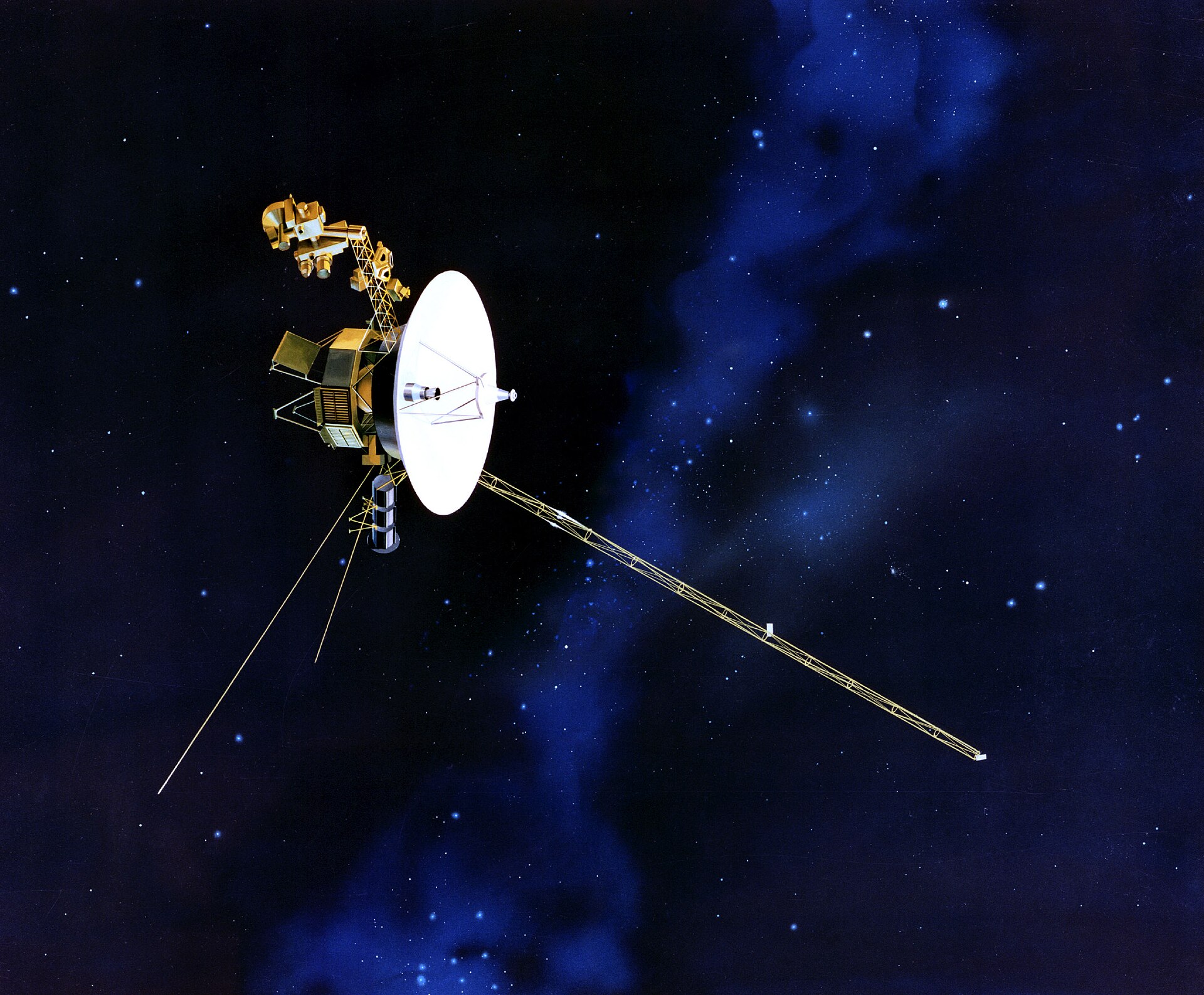
NASA's Voyager 1 spacecraft crossed a distance of one light-day from Earth on Wednesday, Nov. 18, at 5:16:07 a.m. Eastern time, becoming the first human-made object to travel that far, according to NASA. A light-day is the distance light travels in 24 hours: 16,094,799,096 miles, or 25,902,068,356 kilometers.
The milestone arrives while the spacecraft is not returning any science or engineering data. In a mission update posted Nov. 18, NASA said the Voyager 1 team became aware on Nov. 14 that the spacecraft had stopped sending data after a Deep Space Network antenna in Canberra, Australia, "locked on" to the probe and received a carrier signal but no data. The carrier signal is the radio tone that normally carries science and engineering information to ground antennas.
NASA said the team can still confirm the light-day milestone on Thursday, Nov. 19, using the carrier signal and trajectory calculations. The spacecraft travels away from Earth at a consistent speed on a known trajectory and has no way to change its speed, so engineering issues cannot affect when it reaches one light-day, the agency said. Because a signal takes a full day to travel each way, NASA planned its celebration for Nov. 19, a day after the crossing, once the spacecraft's signal is received.
The carrier signal itself tells engineers something. Its presence means Voyager 1's Attitude and Articulation Control computer is keeping the spacecraft pointed at Earth and that its antenna and broadcast equipment still work, NASA said. The lack of data suggests the problem lies with the onboard computer responsible for collecting data from the spacecraft's subsystems, including science instruments, and formatting it for transmission.
Diagnosis will be slow. A radio command takes 24 hours to reach the probe, and its reply takes another 24 hours to return, so finding the cause "may take weeks or longer," NASA said. The team is drawing on a similar episode in 2023, when controllers received a carrier signal but no data and traced the issue to one of the onboard computers.
Engineers are also examining whether the current problem is related to a brief outage in October. On Oct. 18 and 19, the Deep Space Network could not detect any signal from Voyager 1 during two scheduled attempts 24 hours apart; the signal reappeared on Oct. 20 without any commands from the ground, NASA said. Engineers determined that one group of thrusters had gone offline and that backups had turned on automatically, a fault-protection response that puts the spacecraft into a safe configuration. The spacecraft operated normally from then until Nov. 14.
The outage follows a power-saving success. In early September, engineers turned off three devices on Voyager 1 and replaced them with lower-power alternatives, an operation the team nicknamed the "Big Bang." The probes draw power from radioisotope thermoelectric generators and lose about 4 watts a year. Without the swap, NASA said, the mission would have had to turn off another science instrument as early as summer 2027.
Launched in 1977, Voyager 1 is traveling at nearly 38,000 miles per hour toward a star called AC +79 3888, which it is expected to pass within about 1.7 light-years of in 40,000 years. Its twin, Voyager 2, is on pace to reach one light-day in November 2035. NASA has said it expects eventually to lose both spacecraft to unresolvable engineering problems but will keep them operating as long as possible.
What NASA has not yet said is what caused the data stoppage, whether it is connected to October's thruster event and whether the mission expects to restore science data.
Sources
- NASA: Voyager 1 engineers analyze data issue, ready to confirm light-day (Nov. 18, 2026) (opens in a new tab)
- NASA: Voyager 1, what is a light-day? (opens in a new tab)
- NASA: Voyager 1 conserves power, resolves brief communications pause (Oct. 29, 2026) (opens in a new tab)
- Xinhua: Daily World Briefing, Nov. 19 (opens in a new tab)