Cambridge's Council Gets the City Manager's Report on the MWRA Tank Planned Under Magazine Beach, Two Weeks After a 9-0 Vote Against It
Monday's agenda also includes a push for a local-option tenant purchase law, a call to issue demolition and tree-removal permits alongside building permits, and the tabled review of the Harvard Square Kiosk.
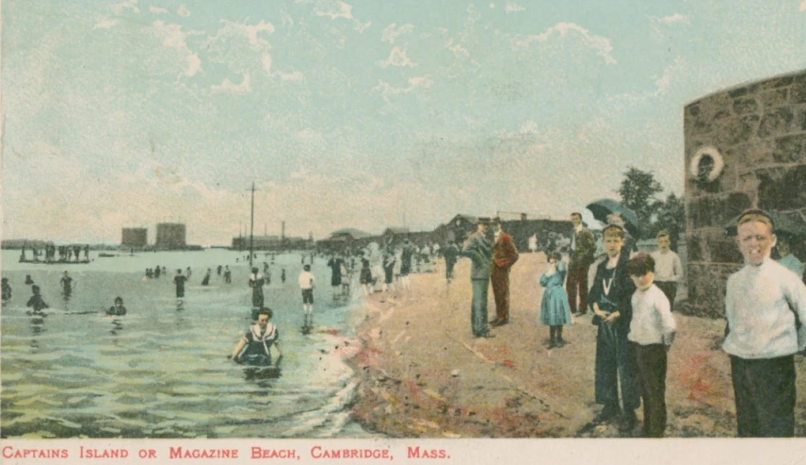
The Cambridge City Council was scheduled to meet at 5:30 p.m. Monday in the Sullivan Chamber and on Zoom with a report from City Manager Yi-An Huang on talks with the Massachusetts Water Resources Authority about a sewage-overflow storage tank the authority has proposed beneath Magazine Beach, according to the agenda summary published by the Cambridge Civic Journal.
The report, listed as Manager's Agenda #1 and responding to council request AR26-66, concerns "discussions with MWRA about improvements to water quality and advancement of CSO infrastructure without taking of public parkland or prolonged disruption to Magazine Beach," the agenda summary says. CSO stands for combined sewer overflow, the discharges of mixed stormwater and sewage that older systems release into rivers during heavy rain.
Two weeks earlier, at the Oct. 19-20 meeting, the council unanimously adopted an amended order asking the MWRA to reconsider plans to construct a 10-million-gallon CSO storage tank beneath Magazine Beach, according to the Civic Journal's record of that meeting. The order listed nine sponsors: Councillors Zusy, Nolan, Mayor Siddiqui, Vice Mayor Azeem and Councillors Al-Zubi, Flaherty, McGovern, Simmons and Sobrinho-Wheeler, and it passed 9-0.
The Civic Journal's editor, Robert Winters, wrote that the MWRA proposal "would require permanently fencing off 2.3 acres of newly restored green space at Magazine Beach" and called it "a non-starter." That characterization is his; the MWRA's own description of the footprint was not included in the agenda summary. The text of the manager's report is linked from the agenda and had not been summarized publicly before the meeting.
Order #4, sponsored by Al-Zubi, Sobrinho-Wheeler, McGovern and Siddiqui, would put the council on record supporting the Tenant Opportunity to Purchase Act and urge the Legislature's conference committee on the economic development bill to adopt the House's local-option version, according to the agenda summary. A tenant opportunity to purchase law gives tenants a chance to buy their building, or assign that right to a nonprofit, when an owner sells. Local option means each city or town would decide whether to adopt it.
Order #3, sponsored by Zusy, Nolan and Siddiqui, asks the city manager to consider "an integrated development review process in which demolition and tree removal permits are reviewed with and issued concurrently with the building permits," the summary says. The order does not specify how the change would be carried out.
Also on the table is a request that the city manager "review and reconsider the Harvard Square Kiosk Operating and Stewardship Model." The order, filed by McGovern, Siddiqui, Simmons and Flaherty, was delayed when Sobrinho-Wheeler exercised his charter right on Oct. 20 and was tabled 9-0 at the Oct. 28 special meeting, according to the Civic Journal. The kiosk's current programming is coordinated by CultureHouse, Winters wrote.
The Oct. 28 special meeting was called to finish two orders that had drawn more than six hours of public comment on Oct. 19 before the meeting recessed at 11:45 p.m., according to the Civic Journal. Winters reported that the council passed a substitute version of the first order, requesting that the Cambridge Retirement Board divest from certain listed investments, and noted that the board is under no obligation to comply because the council has no authority over it. The amended order also asks the city manager to develop and maintain a divestment list, he wrote.
The second order, calling on the city to boycott Israel-connected companies in purchasing and contracting, was defeated without the proposed ordinance being referred to the Ordinance Committee, according to Winters. The Civic Journal earlier recorded a 4-5 vote on a related request for a legal opinion. Winters, who opposed both orders, has written in strong terms about the proponents; his descriptions are his own commentary.
At its Oct. 19-20 meeting, the council also voted 9-0 to go on record opposing statewide ballot Question 5, the proposal to change the state's tax-revenue cap, "due to the consequences this would have for the City of Cambridge and other municipalities," and 9-0 to ask the city manager to encourage residents to use early voting or vote by mail given the complexity of the ballots, the Civic Journal recorded.
Cambridge's Election Commission said it would conduct post-processing of late-arriving ballots on Tuesday, Nov. 10, beginning at 9 a.m. at the Citywide Senior Center, 806 Massachusetts Ave., open for public observation, according to a notice reproduced by the Civic Journal.
The council's Public Safety Committee is scheduled to hold a hearing Nov. 10 on the Police Review and Advisory Board's report covering fall 2025 through the first quarter of 2026, and the Ordinance Committee is scheduled to take up curb-cut regulations Nov. 24, according to the Civic Journal's calendar. A Dec. 15 Ordinance Committee meeting is set to discuss a proposed Tenant Notification of Property Sale Ordinance, a local measure related to the TOPA order on Monday's agenda.
Meetings can be watched on the city's website and on Zoom. Public comment sign-up for regular meetings is handled through the City Clerk's office.